 Fluolab
【Adv.Mater.】中科院固体物理所陈冲|26.17%效率突破!谷胱甘肽赋予钙钛矿电池“自修复”超能力,解决SAM稳定性顽疾
通讯作者: Chong Chen
文章概要
引言
基于自组装单分子层(SAM)的反式钙钛矿太阳能电池虽然展现出极高的光电转换效率,但其商业化道路一直受困于“效率-稳定性”的博弈。SAM材料与衬底(如ITO或NiOx)之间的羟基锚定键在紫外线照射或高温环境下极易断裂,导致空穴传输性能下降,这已成为限制器件寿命的核心技术瓶颈。为了打破这一僵局,陈冲教授团队提出了一种全新的协同稳定策略,通过引入还原型谷胱甘肽(GSH)作为多功能添加剂,实现了偶极调节与氧化还原驱动的“自修复”功能。该研究不仅在微观层面优化了电荷传输动力学,更在宏观层面为器件提供了全场景的化学保护,为钙钛矿电池从实验室走向市场提供了“动态调节与静态保护”兼顾的新思路。
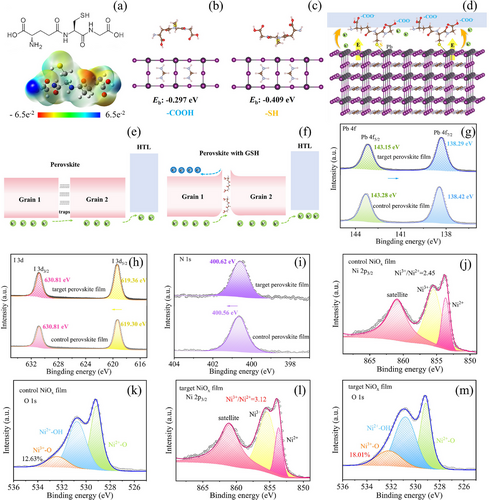
(a) Chemical structure and electrostatic potential distribution of GSH. (b) Schematic diagrams of the FAPbI3/GSH interface (-COOH group) and (c) the FAPbI3/GSH interface (-SH group). (d) Interface electric field of the FAPbI3/GSH interface. (e, f) Transport of charge carriers between pristine perovskite crystals and GSH-modified perovskite crystals. (g–i) XPS spectra of ITO/NiOx/Me-4PACz/Perovskite film: Pb 4f, I 3d and N 1s. (j, k) XPS spectra of control NiOx film: Ni 2p3/2 and O 1s. (l, m) XPS spectra of target NiOx film: Ni 2p3/2 and O 1s
主要实验及结论
研究人员发现谷胱甘肽在钙钛矿薄膜内部呈现垂直梯度分布,主要富集在埋底界面处。通过密度泛函理论计算与XPS表征证实,谷胱甘肽分子的硫醇基团能与未配位的铅离子形成强力的配位键,不仅钝化了体相缺陷,还诱导产生界面偶极,显著加速了光生电荷的分离与传输。在结晶动力学方面,GSH通过其独特的配位作用降低了成核能垒,使钙钛矿晶粒生长更加均匀致密,有效消除了薄膜内部的拉伸应力,从而极大地抑制了离子迁移现象。实验数据显示,改性后的薄膜具有更强的疏水性,能够从源头上抵御水分子的侵蚀。
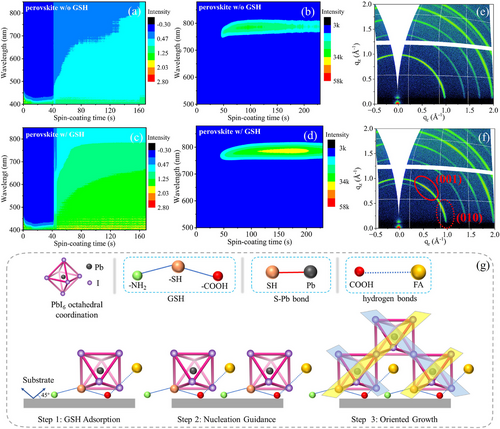
Perovskite crystallization kinetics during the spin-coating process: In situ UV–vis spectra of (a) ITO/NiOx/Me-4PACz/perovskite and (c) GSH-modified perovskite. In situ PL spectra of (b) ITO/NiOx/Me-4PACz/perovskite and (d) GSH-modified perovskite. GIWAXS images of perovskite film (e) without and (f) with GSH. (g) Coordination structures of GSH with the (0 0 1) and (0 1 0) facets of the black-phase FAPbI3 crystal.
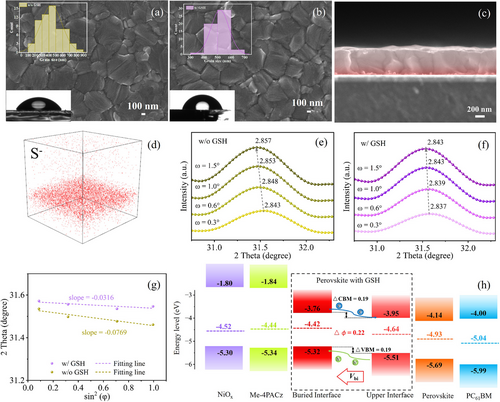
SEM images and water contact angle images of (a) control perovskite film and (b) target perovskite film. (c) Cross-section SEM image of the target perovskite film and (d) corresponding three-dimensional (3D) distribution map of S secondary ions acquired via TOF-SIMS. GIXRD spectra at different tilt angles for (e) the control perovskite film, and (f) the target perovskite film. (g) Linear fitting of 2𝜃-sin2𝜑 for both perovskite films. (h) Energy level arrangement of the PSCs in this work.
最为关键的突破在于氧化还原驱动的自修复机制。在高温或紫外光应力下,谷胱甘肽被氧化为氧化型谷胱甘肽(GSSG),进而将空穴传输层NiOx中的镍元素从二价氧化为三价,生成具有高电导率的NiOOH。这一过程不仅开辟了额外的空穴传输通道,弥补了SAM键合断裂带来的损失,还为SAM提供了更多的羟基锚定位点。基于这一策略,研究团队在小面积电池上实现了26.17%的惊人转换效率,而在12.50平方厘米的大面积组件上也取得了23.14%的高效率,这在同类面积的组件中处于领先水平。在ISOS国际稳定性测试标准下,未封装的器件展现出卓越的耐受性,在经过长达1000小时的黑暗存放或数百小时的湿热测试后,依然保持了初始效率的大部分,特别是其抗紫外线性能远超对比组器件。
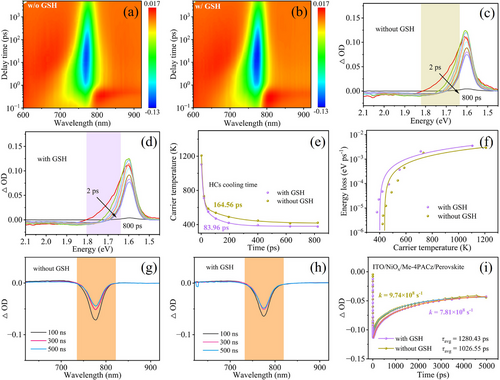
The pseudo-color TA plots of (a) the ITO/NiOx/Me-4PACz/perovskite (without GSH) and (b) that with GSH. TA spectra at early delays of (c) ITO/NiOx/Me-4PACz/perovskite (without GSH) and (d) that with GSH. (e) Hot carrier temperature as a function of delay times for the devices. (f) Power loss as a function of the carrier temperature of the perovskite films. TA spectra at early delays of (g) ITO/NiOx/Me-4PACz/perovskite (without GSH) and (h) that with GSH. (i) Transient absorption decay plots of the ground-state bleaching peak.
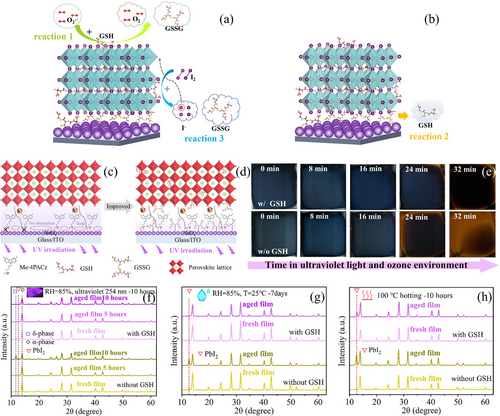
(a) The self-healing process of perovskite films. (b) The chemical reaction leading to enhanced conductivity at the perovskite/HTL interface. Schematic diagram of hole transfer at the buried interface in the (c) control and (d) target devices under high-energy UV irradiation. (e) Photographs of perovskite films with and without GSH after UV-ozone treatment for various durations. Evolution of the XRD patterns of the perovskite films exposed to (f) 85% RH and 254 nm UV irradiation (10 h), (g) 85% RH and 25°C (7 days), and (h) 100°C (10 h).
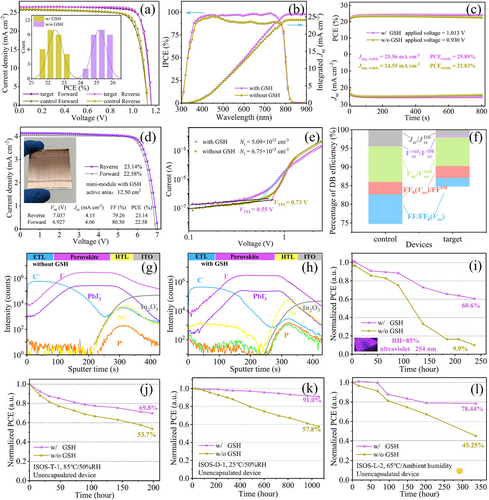
(a) J–V curves under forward and reverse scans for the champion control and GSH-modified devices. (b) IPCE spectra and the corresponding integrated current densities. (c) The steady-state photovoltaic outputs for the PSCs with and without GSH. (d) J–V curves under forward and reverse scans for the target minimodule. (e) SCLC curves of hole-only devices. (f) Visualization of potential improvement for our devices relative to the ideal DB model. TOF-SIMS elemental depth profiles of the (g) control and (h) target devices with GSH. Standardized efficiency aging test for the unencapsulated devices under (i) 254 nm UV light and 85% RH environment, (j) ISOS-T-1, (k) ISOS-D-1, and (l) ISOS-L-2 protocols.
总结及展望
这项工作成功开发了一种低成本且高效的多功能添加剂方案,证明了谷胱甘肽在提升钙钛矿电池效率与多维度稳定性方面的巨大潜力。通过将动态自修复功能与跨尺度静态优化相结合,研究人员不仅解决了SAM基钙钛矿电池的经典失效模式,还建立了一套通用的设计原则。未来,这种“自愈型”界面工程有望应用到更广泛的光电领域,助力高性能、环境稳健型光伏技术的工业化进程。这一成果标志着钙钛矿太阳能电池在克服环境稳定性障碍方面迈出了坚实的一步,为实现绿色能源的高效利用提供了强有力的科学支撑。