 Fluolab
【Angew.Chem.】东华大学吴宏伟、钱成|140纳米超大红移!动态氢键切换策略解锁多刺激响应荧光晶体新境界
通讯作者: Cheng Qian, Hongwei Wu
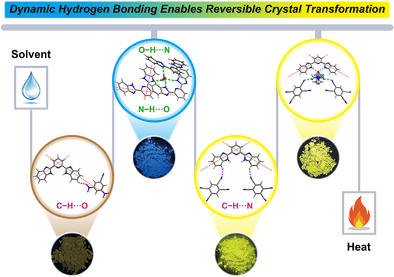
文章概要
引言
在智能材料领域,如何精准控制有机共晶在固体状态下的结构转变以实现多刺激响应荧光,一直是极具挑战性的前沿课题。传统的响应体系往往受限于分子堆积过于紧密,导致格点自由体积不足,难以对外部环境变化做出灵敏反应。为了突破这一瓶颈,研究团队提出了一种动态氢键切换策略,利用具有构型适应性的V型供体分子,通过与水分、极性溶剂及电子受体之间氢键竞争的巧妙平衡,构建了一系列具有可逆晶体转化功能的共晶体系。这项工作不仅实现了荧光波长的大范围调控,还为环境监测、信息加密及防伪等应用提供了全新的 supramolecular(超分子)设计思路。
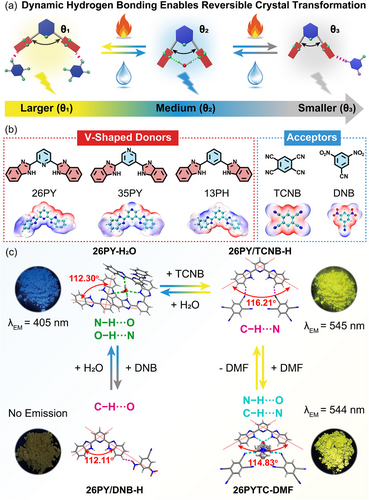
(a) Illustration of dynamic hydrogen-bonding switching enabling reversible crystal transformation. (b) Chemical structures of three V-shaped donors and two acceptors, along with their electrostatic potential (ESP) maps. (c) Reversible switching of different crystalline states: a hydrated intermediate (26PY-H2O), binary cocrystals (26PY/TCNB-H, 26PY/DNB-H), and a ternary cocrystal (26PYTC-DMF). Insets show corresponding luminescence images under 365 nm UV light.
主要实验及结论
研究人员精心设计了三种含有多个氮杂环的V型供体分子(26PY、35PY和13PH),这些分子具备多氢键位点和可调扭转角的特点。实验发现,当供体与电子受体TCNB在含有微量水的弱极性溶剂中研磨时,供体分子会优先捕获水分形成蓝色荧光的含水中间体,此时氢键占据了关键位点,阻碍了供受体间的电荷转移。然而,通过简单的热处理脱水,V型分子的二面角会发生显著调整,从而释放出氢键位点并诱导分子平面化,促使稳定的二元电荷转移共晶形成。这一过程伴随着惊人的视觉变化:荧光从405纳米直接红移至545纳米,红移跨度高达140纳米。
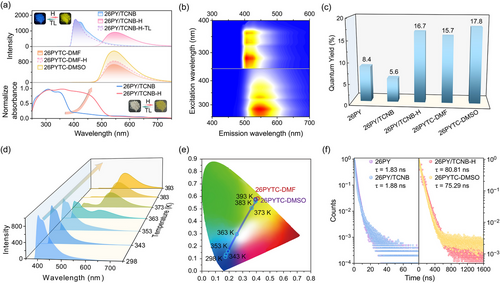
(a) Fluorescence emission spectra of (top) 26PY/TCNB, 26PY/TCNB-H, and 26PY/TCNB-H-TL; (middle) fluorescence emission spectra of 26PYTC-DMF, 26PYTC-DMF-H, and 26PYTC-DMSO; (bottom) normalized solid-state UV–vis absorption spectra of 26PY/TCNB and 26PY/TCNB-H. Insets show corresponding luminescence images under 365 nm UV light (top) and photographs under daylight (bottom). (b) Excitation-emission mapping spectra of (top) 26PY/TCNB and (bottom) 26PY/TCNB-H. (c) Fluorescence quantum yields for 26PY, 26PY/TCNB, 26PY/TCNB-H, 26PYTC-DMF, and 26PYTC-DMSO. (d) Temperature-dependent fluorescence emission spectra of 26PY/TCNB from 298K to 393K. (e) CIE chromaticity diagrams for 26PYTC-DMF and 26PYTC-DMSO, along with the temperature-dependent CIE chromaticity diagram of 26PY/TCNB from 298K to 393K. (f) Transient photoluminescence decay curves for (left) 26PY and 26PY/TCNB, and (right) 26PY/TCNB-H and 26PYTC-DMSO.
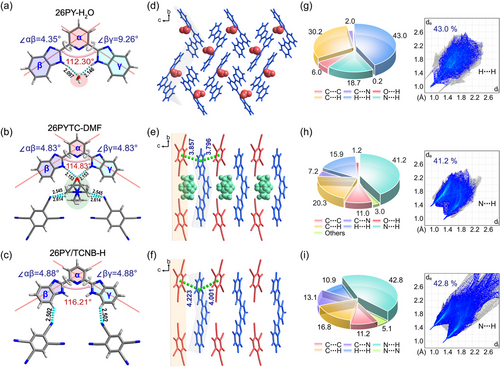
Hydrogen-bonding networks and interplane dihedral angles for (a) 26PY-H2O, (b) 26PYTC-DMF, and (c) 26PY/TCNB-H. 2D supramolecular tiling pattern in the b-c plane of (d) 26PY-H2O crystal (e) 26PYTC-DMF, and (f) 26PY/TCNB-H cocrystal (26PY: Blue, H2O: Red, TCNB: Pink, DMF: Green). Hirshfeld surface contact contributions (%) with corresponding 2D fingerprint plots between de and di of (g) H···H for 26PY-H2O, (h) N···H for 26PYTC-DMF, and (i) N···H for 26PY/TCNB-H.
更令人兴奋的是,这种转换不仅局限于热刺激。在DMF或DMSO等强极性溶剂存在下,供体分子表现出更强的溶剂亲和力,能够直接跨越含水阶段,通过协同的N-H···O和C-H···N/O相互作用形成稳定的三元共晶,且同样表现出显著的电荷转移特征。结构分析进一步揭示,V型分子如同一个“可开合的夹子”,其110.23°至116.21°的动态角度调节是实现多相转换的核心引擎。此外,该体系展现出卓越的耐疲劳性,在长达10次的热/水分循环处理后,其晶体结构与光学性能依然保持高度稳定。
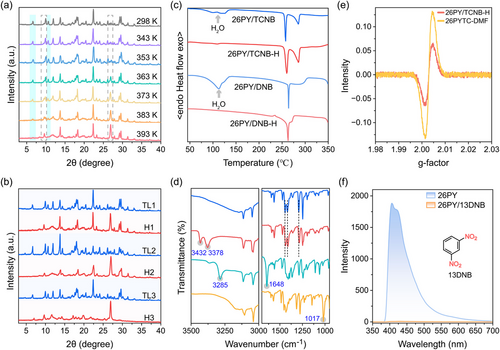
(a) Temperature-dependent PXRD patterns of 26PY/TCNB from 298 K to 393 K. (b) Reversible PXRD patterns of 26PY/TCNB and its dehydrated form 26PY/TCNB-H over three consecutive hydration-solvent‑addition cycles. (c) DSC curves of 26PY/TCNB, 26PY/TCNB-H, 26PY/DNB, and 26PY/DNB-H. (d) FTIR spectra of 26PY/TCNB (blue), 26PY/TCNB-H (red), 26PYTC-DMF (green), and 26PYTC-DMSO (yellow). (e) Electron spin resonance spectra of 26PY/TCNB-H and 26PYTC-DMF. (f) Emission spectra of 26PY and its mixtures with 13DNB.
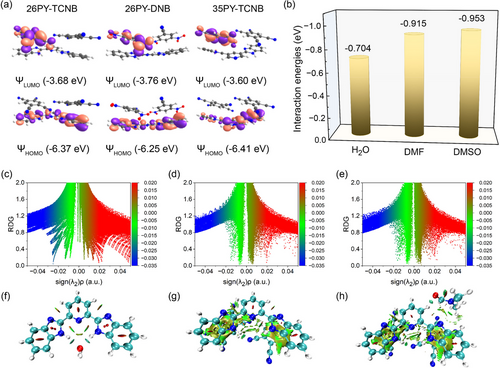
(a) The HOMO and LUMO of 26PY-TCNB, 26PY-DNB, and 35PY-TCNB. (b) Interaction energies of water, DMF, and DMSO molecules with 26PY. RDG of (c) 26PY-H2O, (d) 26PY/TCNB-H, and (e) 26PYTC-DMF. NCI of (f) 26PY-H2O, (g) 26PY/TCNB-H, and (h) 26PYTC-DMF.
在实际应用演示中,团队基于26PY平台开发了多功能感测条。该感测条不仅能作为视觉温度指示计,还能通过荧光淬灭效应实现对13DNB、14DNB等有毒硝基芳香族化合物的高灵敏定量检测。结合26PY/TCNB和26PY/DNB两种材料的不同响应特性,研究者成功展示了多级信息加密方案:同一图案在紫外灯下初始均显蓝色,经加热后一部分变为黄色荧光,另一部分则完全消失,通过溶剂喷雾又能恢复原状,展现了极高的防伪维度。
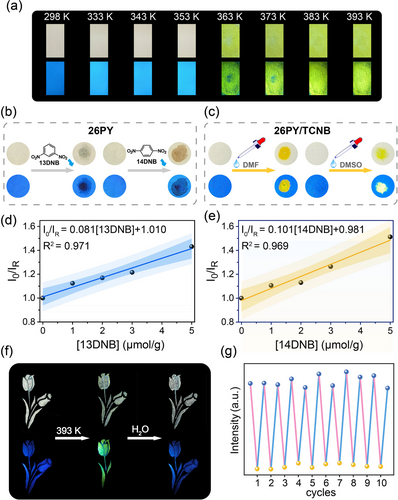
(a) Temperature-dependent color and fluorescence changes of 26PY/TCNB test strips recorded under daylight (top) and 365 nm UV light (bottom) from 298K to 393K. (b) Visual and fluorescent response of 26PY test strips after exposure to DMSO solutions of 13DNB and 14DNB. (c) Color and fluorescence switching of 26PY/TCNB test strips upon treatment with DMF or DMSO, showing under daylight (top) and UV light (bottom). Linear calibration curves of 26PY in response to different concentrations of (d) 13DNB and (e) 14DNB. I0 and IR represent the emission intensities of 26PY before and after exposure to 13DNB or 14DNB at different concentrations, respectively. (f) Multi-level information encryption based on 26PY/TCNB and 26PY/DNB composites. (g) Thermal cycling stability of 26PY/TCNB over 10 repeated heating-H2O recovery cycles.
总结及展望
本研究通过创新的动态氢键切换策略,成功克服了有机共晶响应灵敏度差和合成复杂的难题。这种利用构型自适应分子调控晶相转换的方法,为开发高性能刺激响应发光材料开辟了新路径。这种体系不仅在热敏传感、极性溶剂识别及精密防伪领域展现出巨大的产业化潜力,也为未来设计更复杂的自愈合材料和光电子器件提供了重要的理论支撑。研究团队表示,未来将进一步拓展该类V型分子的结构库,探索其在生物成像及更广泛的光电转换领域的应用可能。