 Fluolab
【JACS】中科院新疆理化所潘世烈、韩健|2.4倍KDP响应!JACS:局部构象锁定策略突破深紫外非线性光学晶体性能瓶颈
文章标题: Local Conformational Confinement and Dipole Engineering for Phase-Matchable Solar-Blind Ultraviolet Nonlinear Optical Crystals
通讯作者: Jian Han (韩健), Shilie Pan (潘世烈)
文章概要
引言
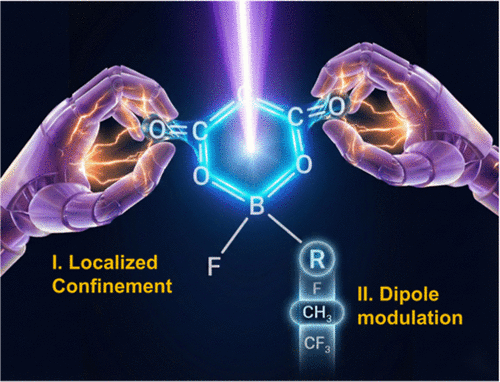
在当前激光技术领域,开发高性能的日盲紫外(Solar-blind UV)非线性光学晶体面临着极其严峻的挑战,这主要源于材料必须同时满足非中心对称结构、足够的双折射以实现相位匹配以及宽带隙这一“不可能三角”。传统的材料设计往往难以在增强非线性响应的同时保持紫外透明度。针对这一难题,中科院新疆物理化学技术研究所的潘世烈研究员和韩健研究员团队提出了一种全新的局部构象约束策略。他们通过将柔性的丙二酸根配体螯合到四面体硼原子上,构建出刚性的六元环结构,这种几何锁定效应不仅显著增强了材料的极化率各向异性和微观超极化率,还成功维持了宽阔的带隙,为开发新一代紫外光学材料开辟了新路径。
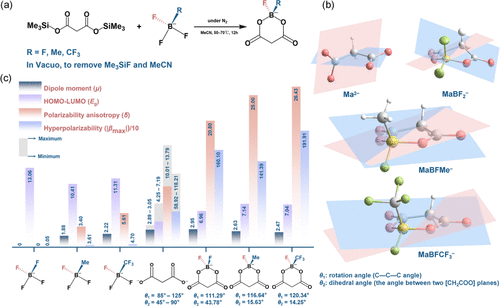
Figure 1. (a) Synthetic route of NaC3H2O4BFR (NaMaBFR), R = F, Me, CF3, Ma represents the malonate group. (b) Geometric schematic diagram of the involved microunits: yellow spheres: B; gray spheres: C; pink spheres: O; green spheres: F; white spheres: H. (c) The geometric structures of the involved microfunctional groups and their linear and nonlinear optical properties have been studied. The calculation was carried out using density functional theory (DFT) implemented by the Gaussian09 package at the 6-31G level.
主要实验及结论
研究人员通过精妙的化学合成,将丙二酸双(三甲基硅烷)酯与含氟硼酸盐在无水乙腈环境下反应,成功制备了一系列新型功能基元。计算分析表明,这种螯合作用将丙二酸根中两个π共轭单元的二面角限制在极小的范围内,这种空间禁锢效应赋予了材料优异的电子离域特性。实验发现,通过改变硼原子上的取代基,可以有效地调节阴离子单元的基态偶极矩。在 NaMaBF2 中,由于偶极矩较大,晶体倾向于以中心对称方式排列,从而失去了非线性活性;而引入甲基或三氟甲基取代后,NaMaBFMe 和 NaMaBFCF3 的偶极相互作用减弱,促使晶体转向非中心对称的空间群。
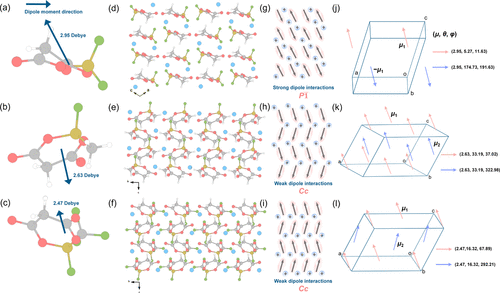
Figure 2. Static dipole moments of the microscopic components, crystal structure characteristics, and molecular dipole–dipole interactions. (a–c) Schematic illustrations of the anionic group structures and the crystalline dipole moments in NaMaBF2, NaMaBFMe, and NaMaBFCF3, respectively. (d–f) Packing diagrams of the crystal structures for NaMaBF2, NaMaBFMe, and NaMaBFCF3, respectively. (g–i) Schematic representations of the dipole–dipole interactions within the crystals of NaMaBF2, NaMaBFMe, and NaMaBFCF3, respectively. The pink ellipsoids represent typical dipolar anions, while the blue spheres denote the nondipolar cations. (j–l) Represent the dipole vector mappings in the NaMaBF2, NaMaBFMe, and NaMaBFCF3 crystals, respectively. In the crystallographic orthogonal coordinate system, spherical coordinates are defined with the polar axis direction taken from the c-axis direction and the X-axis direction taken from the projection of the a-axis onto the XY plane. The spherical coordinates of each dipole vector are annotated.
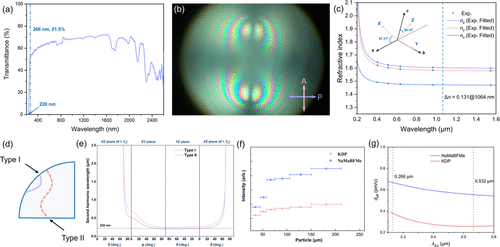
Figure 3. (a) UV–vis–NIR transmittance spectrum of NaMaBFMe crystal. (b) Conoscopic interference pattern of a NaMaBFMe crystal, showing typical lemniscate fringes for a biaxial crystal; the isogyres split and shift upon stage rotation. (c) Experimentally measured refractive indices of NaMaBFMe at five wavelengths (407, 514, 636, 965, and 1547 nm) using the prism-coupling method, together with the best-fit dispersion of the refractive index _n_i versus wavelength λ according to the Sellmeier equation (least-squares fitting). (d) Reference trajectory of the PM surface for NaMaBFMe. (e) Calculated type-I and type-II PM curves for SHG in the three principal planes of NaMaBFMe based on the Sellmeier equations. (f) Comparison of SHG intensities between powdered NaMaBFMe and KDP as a function of particle size under 1064 nm fundamental radiation. (g) Comparison of the effective nonlinear coefficients (_d_eff) of NaMaBFMe and KDP at different fundamental wavelengths. For type-I PM (ooe), _d_eff (NaMaBFMe) = _d_12cos θ – _d_32sin θ, while_d_eff (KDP) = – _d_36sin θsin 2φ. The angle range of V__z is from 68.15° to 68.34° within the range of λω from 1064 to 532 nm for NaMaBFMe. PM angles (θ) and azimuthal angles (φ) for NaMaBFMe and KDP were obtained from their respective Sellmeier equations. The _d_12 and _d_32 values for NaMaBFMe were derived from first-principles calculations.
在性能表征中,NaMaBFMe 展现出了令人瞩目的综合素质。它不仅拥有约 220 nm 的紫外截止边,在 1064 nm 处的双折射率更是高达 0.131,这一数值与著名的 BBO 晶体相当,确保了其在整个透光范围内均能实现相位匹配。最关键的是,其实验测得的二次谐波(SHG)强度达到了 KDP 晶体的 2.4 倍。此外,该晶体还具备极高的抗激光损伤阈值,达到 1.258 GW/cm²,远超许多现有的有机或半有机非线性光学材料,充分证明了其在高功率激光系统中的应用潜力。
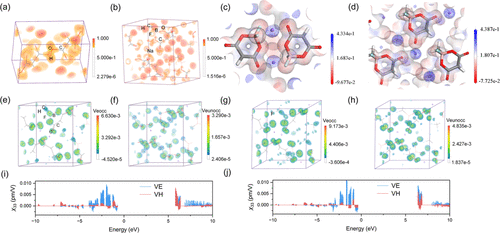
Figure 4. (a, b) Electron localization function (ELF) diagrams for malonic acid and NaMaBFMe. (c, d) Electrostatic potential (ESP) analysis of NaMaBF2 and NaMaBFMe. (e, f) SHG-weighted densities of occupied and unoccupied states in the virtual electron (VE) process of NaMaBFMe. (g, h) SHG-weighted densities of occupied and unoccupied states in the virtual electron (VE) process of NaMaBFCF3. (i, j) The band-resolved NLO susceptibility of NaMaBFMe and NaMaBFCF3.
总结及展望
这项研究通过局部构象锁定与偶极工程的协同作用,成功打破了柔性π共轭体系在晶体堆积和光学性能上的局限性。团队建立的这种“几何-偶极-堆积-性能”关联模型,为从柔性分子出发设计高性能功能材料提供了普适性的指导。NaMaBFMe 晶体的成功合成,不仅提供了一种极具竞争力的日盲紫外非线性光学晶体候选者,也标志着分子水平上的精确构象控制已成为突破光电材料性能极限的重要手段。未来,这种设计策略有望推广到更多光电功能晶体的开发中,助力全固态紫外激光器向小型化和高效化迈进。