 Fluolab
【Angew.Chem.】突破400 cd/m²!POCl₃自调节钝化技术助力全无机钙钛矿实现高亮度紫光LED
通讯作者:Junzhi Ye, Akshay Rao, Bo Ram Lee, Robert L. Z. Hoye, Lakshminarayana Polavarapu
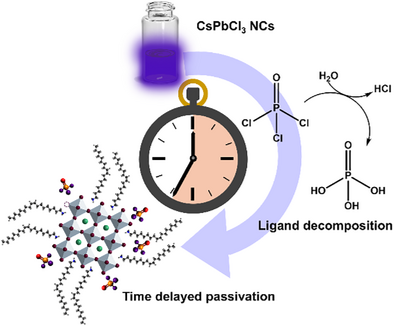
文章概要
引言
在钙钛矿光电领域,CsPbCl₃纳米晶因其极高的色彩纯度和窄发射带宽,被认为是制备紫光发光二极管(LED) 的最具潜力材料之一。然而,与研究较成熟的溴化物或碘化物相比,氯化物钙钛矿的带隙较宽,极易产生深能级缺陷,且其缺陷容忍度较低。传统的油胺配体虽然能起到一定的稳定作用,但制备出的纳米晶荧光量子产率(PLQY)通常仅为1%至3%,且在洗涤和储存过程中性能会迅速退化。如何实现高效且长期稳定的氯基钙钛矿紫光发射,一直是制备高性能紫光LED面临的巨大挑战。
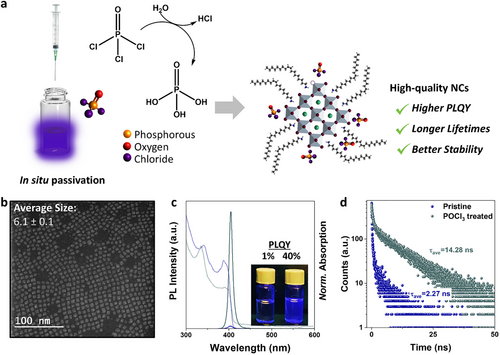
(a) Scheme of in situ passivation mechanism with POCl3 on CsPbCl3 NCs, where we introduce the POCl3 passivator directly in the precursor solution. The POCl3 molecules added during the synthesis will gradually release Cl− ions and form phosphate and phosphoric acid to repair the Cl vacancies leading to surface passivated crystals; accordingly, the data presented in the following graphs correspond to samples aged 15 days. (b) STEM image of CsPbCl3 NCs treated with POCl3. (c) Normalized PL Intensity to the absorption at excitation wavelength and absorption normalized to the maximum of pristine CsPbCl3 and POCl3 treated NCs. (d) Time-resolved photoluminescence decay of pristine and POCl3 treated NC drop-cast films. The excitation source is a nanosecond pulsed laser with a 350 nm wavelength (41.88 µJ/cm2 fluence).
主要实验及结论
研究团队独辟蹊径地引入了三氯氧磷(POCl₃) 作为一种富含卤素的分子钝化剂。实验发现,将POCl₃直接加入反应体系进行原位钝化,能够产生一种奇特的 “延迟增强”效应。与传统处理后性能立即衰减的情况不同,POCl₃处理过的纳米晶在储存过程中,PLQY会随时间推移逐步提升,在约15天后达到峰值,较原始样品提升了40倍以上,且在环境条件下存放两个月仍能保持极高的稳定性。这种独特的自修复行为归功于POCl₃在痕量水分诱导下的缓慢水解,它能持续释放出氯离子来填补卤素空位,同时生成的膦酸物种能与铅原子强力螯合,有效抑制了深能级缺陷状态。
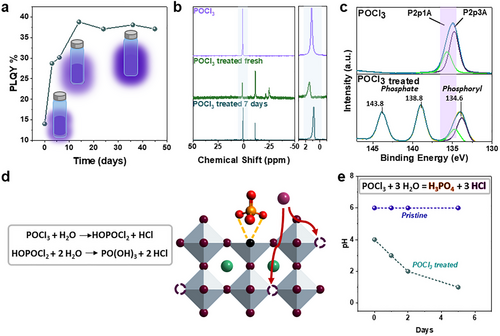
(a) PLQY over aging time for colloidal CsPbCl3 NC solutions prepared by in situ passivation with POCl3. (b) 31P NMR spectra for the pure POCl3, and POCl3 treated sample, fresh and after 7 days. (c) XPS spectra of phosphorous core levels for POCl3 and the treated NCs. (d) Scheme of dual passivation mechanism of CsPbCl3 NCs where chloride is labeled in purple and the group POOH in red and orange. The POCl3 gradually decomposes into phosphoryl group (─P (═O)(─O−)2) and phosphoric acid (H3PO4) (e) pH over time of pristine and POCl3 treated sample with a noticeable increase in acidity overtime due to the formation of phosphoric acid.
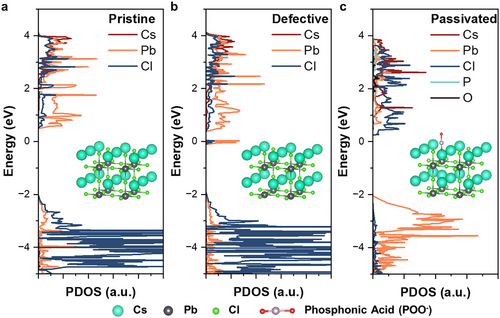
Calculated density of states for pristine CsPbCl3 NCs, defective CsPbCl3 NCs and passivated CsPbCl3 NCs with a phosphonic acid functional group. The insets show the structure of the unit cells. The supercell used is 2 × 2 × 1. There is clear mid gap defect states for the defective supercell with Cl missing. The release of Cl ions and phosphoric acid group from POCl3 successfully remove the mid-gap states after recompensating the Cl vacancies and coordinating the unbound Pb2+ states.
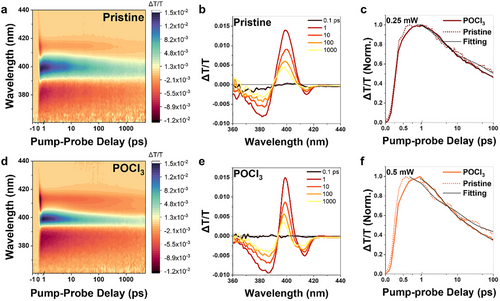
Transient absorption spectroscopy for pristine and passivated CsPbCl3 NCs. (a) TA map of pristine sample at 0.5 mW. (b) TA spectra of the pristine sample at 0.5 mW. (c) Experimental and fitted TA decay curve of pristine and passivated samples probed at 395–405 nm at 0.25 mW. (d) TA map of POCl3-treated sample at 0.5 mW. (e) TA spectra of the passivated sample at 0.5 mW. (f) Experimental and fitted TA decay curve of pristine and passivated samples probed at 395–405 nm at 0.5 mW. The samples are pumped by a 355 nm laser.
通过瞬态吸收光谱(TA) 和密度泛函理论(DFT)计算进一步证实,这种双重钝化机制显著降低了激子-激子湮灭速率,并将激子寿命从2.27 ns延长至14.28 ns。在器件层面,研究人员利用这种高性能纳米晶制备了紫光LED,其开启电压仅为3.9 V,峰值亮度达到了409 cd m⁻²。这一数值刷新了目前文献中报道的CsPbCl₃基紫光LED的最高亮度纪录,证明了POCl₃在调控宽带隙钙钛矿表面缺陷方面的卓越能力。
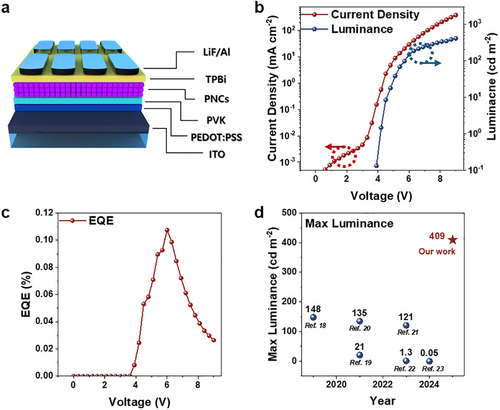
Passivated CsPbCl3 nanocrystal LEDs. (a) LED device structure. (b) Current density/Luminance and voltage curve. (c) Device EQE and voltage curve (d) Maximum luminance of perovskite violet-LEDs of this work and reported values in literature
总结及展望
本研究成功展示了利用富含卤素的双功能分子实现钙钛矿缺陷长期控制的新策略。通过POCl₃的水解特性,实现了卤素释放与表面螯合的自调节平衡,解决了氯基钙钛矿稳定性差和效率低的痼疾。这项工作不仅为实现高亮度、高稳定性的紫光光电器件提供了切实可行的技术路径,也为其他宽带隙半导体材料的表面钝化设计提供了重要的理论参考。未来,通过进一步优化空穴传输层与钙钛矿层的界面匹配,这类紫光LED的器件寿命和外量子效率有望得到更大幅度的突破。