 Fluolab
【Angew.Chem.】废弃塑料“变废为宝”,混合聚酯上回收率最高可减排31%
文章标题: Aqueous Upcycling of Polyethylene Furanoate From Mixed Plastic Feeds Into Metal-Organic Frameworks
通讯作者: Tristan T. Y. Tan, Kai Lan, Jason Y. C. Lim
文章概要
引言
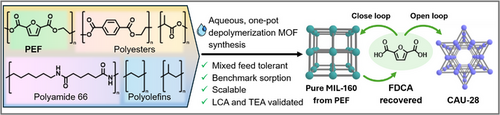
目前全球每年产生近4亿吨塑料垃圾,但回收利用率不足9%,其中混合与污染的塑料废弃物是实现循环经济的最大障碍,因为传统的回收技术往往要求极其严苛的预分选。本文提出了一种全新的免分选上回收方法,将生物基聚酯聚呋喃二甲酸乙二醇酯(PEF) 在水相体系中直接转化为高附加值的金属有机框架材料(MOF)MIL-160。这一过程不仅能够容忍包括PET、PLA、PP等在内的多种塑料混合物,更通过将提纯步骤嵌入到反应过程中,实现了从低价值废弃物向高端功能材料的跨越。这种策略避开了传统回收中昂贵的分选步骤,为生物基塑料的生命周期管理提供了更具经济吸引力的方案。
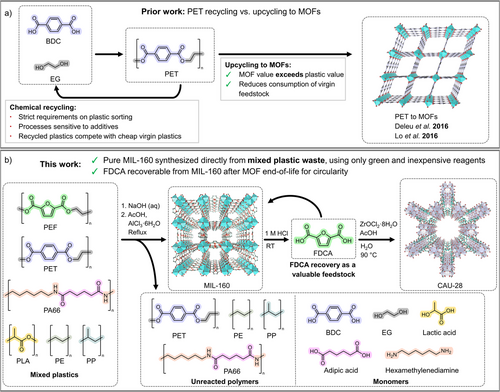
a) Schematic comparison of PET chemical recycling vs. PET upcycling to MOFs reported in prior studies, b) Schematic illustration of this work: selective upcycling of PEF from mixed plastic streams into phase-pure MIL-160. Purified FDCA can be recovered from MIL-160 at end-of-life and reused to synthesize CAU-28, demonstrating circularity and versatility of the recovered monomer.
主要实验及结论
研究团队首先开发了一套串联一锅法工艺。在碱性条件下,PEF可以实现完全降解,随后通过加入醋酸中和并与氯化铝反应,在水溶液中直接生成高纯度、高结晶度的MIL-160。实验结果显示,该方法在处理真实的后消费塑料时表现出极强的鲁棒性。当面对PEF与PET(饮料瓶、餐盒等)的混合物时,由于PEF的碱解速率显著快于PET,团队利用选择性沉淀策略,成功将少量降解产生的对苯二甲酸(BDC)去除,从而保证了生成的MIL-160在化学和相位上的纯净。即使是在由PEF、PET、PLA、尼龙、聚乙烯和聚丙烯组成的六种混合塑料体系中,所得MOF材料的孔隙率和吸附性能依然保持优异,其在二氧化碳捕集和水蒸气吸附方面的表现与使用商品级原料制备的材料完全一致。
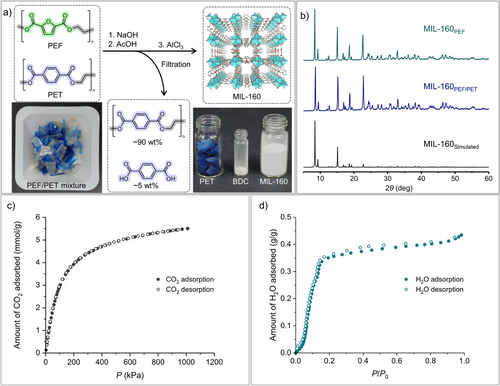
a) Schematic illustration of the upcycling process for a mixture of PEF and post-consumer blue-dyed PET. Photographs show the starting plastic mixture, separated PET, precipitated BDC, and the MIL-160 product. b) XRD patterns of MIL-160 synthesized from pure PEF, from PEF/PET mixtures, and the simulated pattern from the MIL-160 crystal structure for comparison. c) CO2 sorption isotherms at 313 K for MIL-160 synthesized from the PEF/PET mixture. d) H2O sorption isotherms at 303 K for MIL-160 synthesized from the PEF/PET mixture.
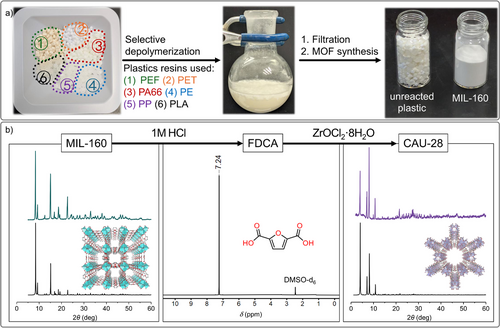
a) Schematic overview of the upcycling process, starting from a mixed plastic resin mixture comprising six polymers: (1) PEF, (2) PET, (3) PA66, (4) PE, (5) PP, and (6) PLA, as shown in the numbered regions of the weighing boat. Hydrolysis is performed using aqueous NaOH, followed by precipitation of BDC, filtration, and MOF synthesis. The resulting product is MIL-160, while the unreacted plastics are cleanly separated. b) Schematic illustration of the quantitative recovery and reuse of FDCA from phase pure MIL-160 made from mixed plastics (XRD shown on left). Digestion of MIL-160 in 1 M HCl at room temperature yields aqueous AlCl3 and precipitated FDCA, purity confirmed by 1H NMR spectroscopy (center). The recovered FDCA is then used to synthesize phase pure CAU-28 (XRD shown on right).
为了进一步证明该系统的可持续性,研究者还探讨了MOF材料本身的末端处置问题。通过简单的酸消化过程,可以定量回收高纯度的2,5-呋喃二甲酸(FDCA)单体。这些回收的单体可以再次循环用于合成其他类型的框架材料(如CAU-28),实现了单体在材料间的闭环循环。生命周期评估(LCA)数据表明,相比于直接使用生物质原料生产,利用混合PEF/PET塑料生产MIL-160可使全球变暖潜势(GWP)降低31%。同时,技术经济分析(TEA)也证实了该路线的经济竞争力,其最低销售价格远低于目前工业生产MOF的估算成本,展示了极佳的产业化前景。
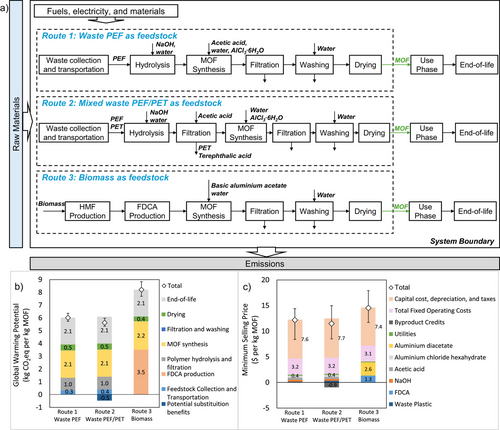
a) The system boundary of life cycle assessment and process flow diagram in three routes of producing metal-organic framework. The system boundary of the life cycle assessment for MOF is cradle-to-gate. HMF stands for 5-hydroxymethylfurfural; FDCA stands for furan dicarboxylic acid. b) The life-cycle Global Warming Potential of producing 1 kg metal-organic framework in various routes. c) The minimum selling price of 1 kg metal-organic framework in various routes. The positive values in b. indicate the greenhouse gas emissions; the negative values represent the potential substitution benefits of byproducts. The error bars represent the value differences between fifth percentile or 95th percentile and mean values. Route 1 utilizes waste PEF for MOF production; Route 2 adopts mixed waste PEF and PET for MOF production; Route 3 starts with lignocellulosic biomass to produce MOF via FDCA. Source data are provided in the Supporting Information.
总结及展望
这项研究成功展示了将PEF从混合塑料废弃物中提炼并上回收为高价值MOF材料的全生命周期路径。这种绿色水相合成路线避免了大量有机溶剂的使用,符合绿色化学原则,并解决了生物基塑料在传统垃圾处理流中难以处理的痛点。这种“变废为宝”的模式不仅提升了废弃塑料的经济价值,更通过单体回收与再利用构建了一个灵活的资源库。随着MOF材料在碳捕集、热能管理等领域的工业化进程加速,这种以废弃塑料为原料的生产方式,将为实现塑料工业的去碳化和循环经济提供关键的技术支撑。