 Fluolab
【Angew.Chem.】太原理工大学吴旭、邓杨调控COF堆叠角度实现98%甲苯降解,光催化领域迎新突破
通讯作者: Yang Deng, Xu Wu
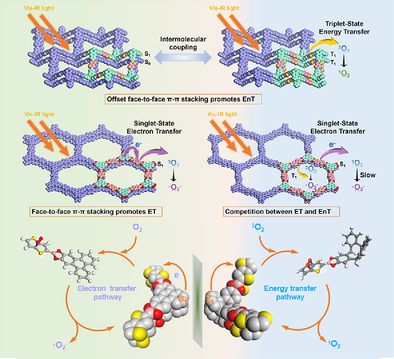
文章概要
这篇研究论文提出了一种通过精确调节二维共价有机框架(COFs)层间偏移π-π堆叠来切换单线态(S1)电子转移与三线态(T1)能量转移路径的新策略。研究人员合成了三种具有不同偏移堆叠角度(90°、105°和128°)的COFs材料,并发现层间滑移行为能显著影响激子动力学。实验结果表明,优化的堆叠方式能够增强库仑相互作用并促进系间窜越(ISC),从而产生高浓度的单线态氧。在光催化降解甲苯的应用中,这种基于三线态能量转移的机制表现出了极其卓越的性能,实现了98%以上的降解效率,为设计高性能环境修复光催化剂提供了全新的理论指导和实验依据。
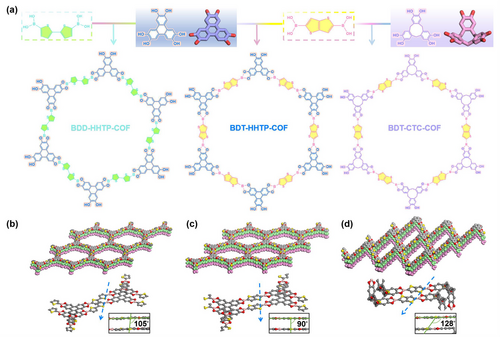
(a) The synthetic routes and chemical structures of the COFs. The space-filling model of (b) BDD-HHTP-COF, (c) BDT-HHTP-COF, and (d) BDT-CTC-COF.
引言
光催化作为利用太阳能驱动化学转化的重要手段,其核心在于调控半导体中光生电子-空穴对的动力学行为。通常情况下,电子转移(ET)和能量转移(EnT)是两条相互竞争的路径,而能量转移路径由于能够绕过物理电荷迁移步骤、抑制载体复合,在复杂基质中表现出更强的鲁棒性和选择性。然而,如何在有机半导体中实现S1和T1激子能量的灵活切换一直是一个挑战。二维COFs材料因其预设计的晶体多孔结构,为在原子尺度上精确调节层间相互作用提供了可能。通过引入折叠构建单元,研究团队试图利用层间偏移堆叠产生的π-σ吸引力来诱导系间窜越,从而提高三线态激子的群数,以达到优化光催化效率的目的。
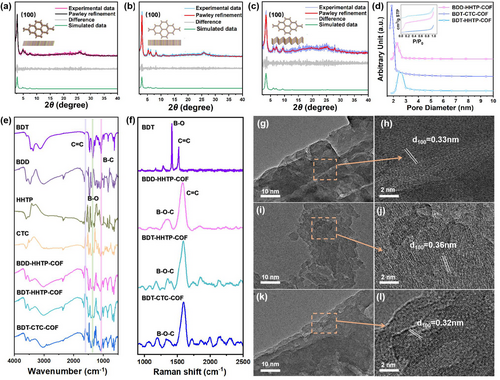
The experimental diffraction diagram and the simulated diffraction diagram of (a) BDD-HHTP-COF, (b) BDT-HHTP-COF, and (c) BDT-CTC-COF. (d) Nitrogen sorption isotherms and pore size distribution of the COFs; (e) FT-IR spectra and (f) Raman spectra of monomers and the COFs; (g-l) HR-TEM of the COFs.
主要实验及结论
研究人员通过硼酸的脱水缩合反应,将不同的折叠构建单元整合进骨架,成功合成了BDT-CTC-COF、BDT-HHTP-COF和BDD-HHTP-COF三种材料。结构表征和理论模拟确认了它们分别具有不同的层间偏移模式和孔隙率。在光物理性质研究中,BDT-CTC-COF表现出了最强的光致发光强度和最长的寿命,这暗示其具有增强的系间窜越过程。通过瞬态光电流和表面电势分析,研究发现面对面堆叠的BDT-HHTP-COF更倾向于电子转移路径并产生超氧自由基,而具有最佳偏移距离的BDT-CTC-COF则通过能量转移路径产生了极高浓度的单线态氧。
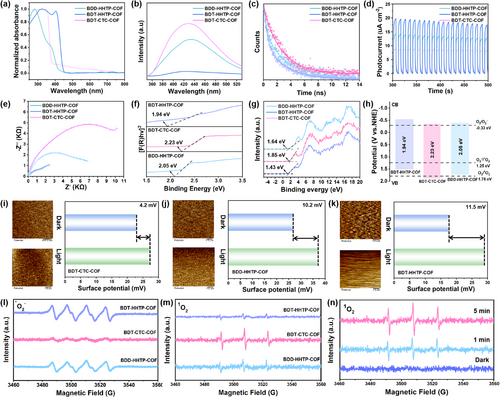
(a) UV–Vis DRS absorption spectrums of the COFs. (b) PL spectra of the COFs. (c) TRPL decay spectra of the COFs. (d) Transient photocurrent responses of the COFs. (e) EIS of the COFs; (f) Tauc plots of the COFs. (g) The XPS valence band of the COFs. (h) Schematic illustration of the electronic band structures of the COFs. (i–k) KPFM surface potential image of the COFs and corresponding potential difference before and after illumination. (l) EPR spectra of •O2− in the presence of DMPO. (m–n) EPR spectra of 1O2 in the presence of TEMP.
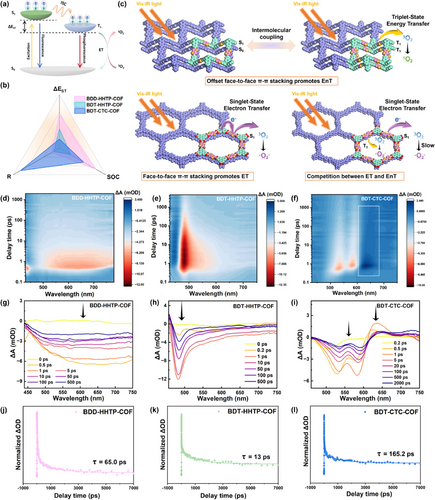
(a) Plausible energy transfer processes for triplet-excitons generation and 1O2 generation. (b) Radar plot showing the major photophysical properties of the COFs. (c) The mechanism schematic diagram of the COFs for photocatalytic activation of oxygen. (d) Fs-TAS and the corresponding signals of (d) BDT-HHTP-COF, (e) BDD-HHTP-COF, and (f) BDT-CTC-COF; Fs-TAS 2D plot of (g) BDT-HHTP-COF, (h) BDD-HHTP-COF, and (i) BDT-CTC-COF; Decay kinetic plots of (j) BDT-HHTP-COF, (k) BDD-HHTP-COF, and (l) BDT-CTC-COF.
密度泛函理论(DFT)计算进一步揭示了机制:偏移堆叠导致HOMO与LUMO的重叠减小,降低了单三线态能隙(ΔEST),显著提高了系间窜越速率。飞秒瞬态吸收光谱实验验证了BDT-CTC-COF中三线态激子的快速生成与转换过程。在实际的甲苯氧化模型反应中,BDT-CTC-COF在短短30分钟内就达到了98.68%的惊人降解率,其动力学常数是常规堆叠方式的5倍。更重要的是,该系统实现了80%的二氧化碳矿化率,展现了极强的彻底净化能力。原位红外光谱分析清晰地展示了反应过程中中间体的动态变化,进一步证实了由单线态氧主导的非自由基氧化机制在攻击芳香环方面的优越性。
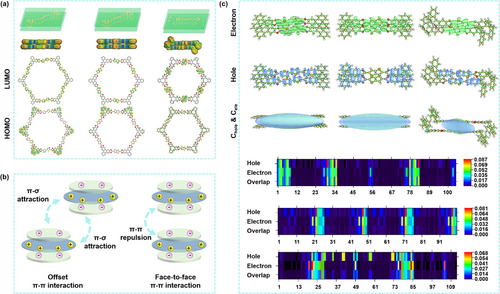
(a) Electronic density distribution and HOMO–LUMO of the COFs. (b) Different electrostatic interaction diagrams of offset and face-to-face stacking between aromatic rings. (c) Distribution of holes (blue)-electrons (green) and contribution of atoms to holes and electrons of the COFs.
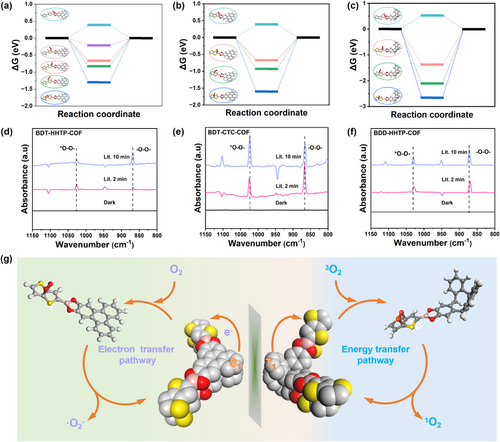
(a–c) Gibbs free energy diagrams of oxygen at different COF sites. (d–f) In situ DRIFTS spectra for the photocatalytic system of the COFs. (g) The activation mechanism of both energy transfer via T1 in BDT-CTC-COF and electron transfer through S1 in BDT-HHTP-COF, without the need for co-catalysts and sacrificial agents.
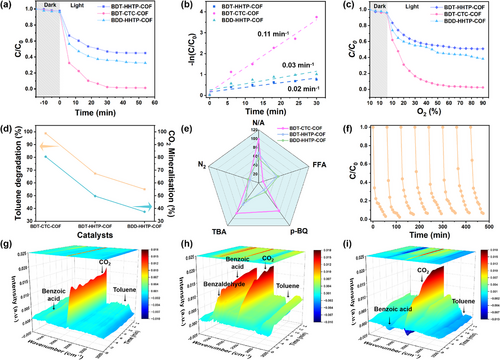
(a) The degradation curves of toluene over the COFs. (b) The fitted pseudo first-order rate constant of the COFs. (c) The degradation curves of toluene over the COFs under different oxygen ratios. (d) The toluene degradation and CO2 mineralization of the COFs. (e) The degradation of toluene during the photocatalytic oxidation reaction over the COFs with different scavengers. (f) The stability test of the COFs. (g–i) In situ FTIR spectra of the COFs in the photocatalytic oxidation of toluene process.
总结及展望
该研究成功展示了通过结构工程调控有机骨架材料激子行为的强大潜力。通过对层间堆叠角度的微小调节,实现了从单线态电子转移向三线态能量转移的完美切换,这不仅极大地提升了光生激子的利用效率,还改变了活性氧物种的生成种类。这种基于三线态激子介导的单线态氧生成机制,在处理工业废气(如甲苯)方面表现出高活性、高稳定性和高矿化度的特点。这一成果不仅丰富了COFs材料在光化学领域的理论基础,也为开发新一代高效、精准、环境友好的光催化体系开辟了新的道路,对于推动绿色化学和环境治理技术的发展具有重要意义。