 Fluolab
【Angew.Chem.】华南理工大学夏志国|性能突破!光产率高达25683 Ph/MeV的晶圆级透明陶瓷,开启X射线/近红外双模成像新篇章
通讯作者: Zhiguo Xia
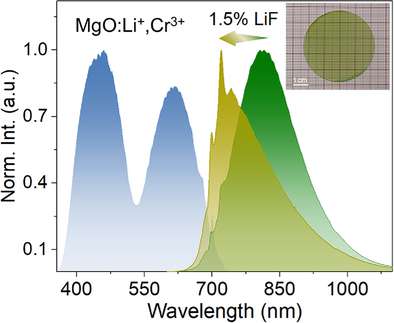
文章概要
引言
在无损检测和生物医学分析领域,将X射线成像与近红外(NIR)成像相结合具有巨大的应用潜力。X射线具有极强的穿透深度和元素特异性,但在面对复杂结构时常受到散射伪影的干扰;而近红外光在生物和聚合物组织中表现出优异的抗散射性能,能够实现高对比度的深层成像。然而,开发出兼具高光产率和优异稳定性的透明闪烁体仍是一项重大挑战。目前的金属卤化物或量子点闪烁体往往存在环境稳定性差、毒性担忧以及有机基质老化等问题。针对这些痛点,研究团队开发了一种基于氧化镁(MgO)基底的新型透明陶瓷闪烁体,通过精细的成分调节和结构设计,成功实现了高性能的X射线/近红外双模融合成像。
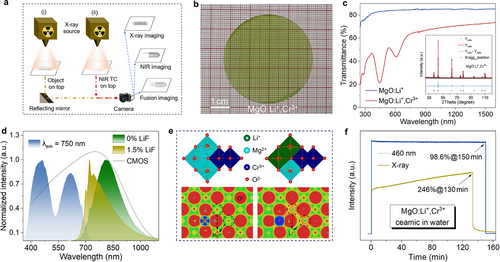
(a) Schematic illustration of X-ray and NIR dual-modal imaging. (b) Photograph of the MgO:Li+,Cr3+ ceramic under natural light (0.4 mm in thickness). (c) UV–Vis–NIR transmission spectra of MgO:1.5%Li+ and MgO:Li+,Cr3+ ceramics, with the inset showing the Rietveld-refined XRD pattern of the latter. (d) PL and PLE spectra of MgO:Li+,Cr3+ (yellow and blue lines, respectively), PL spectrum of MgO:0.5%Cr3+ (green line), and wavelength response curve of red-sensitive CMOS detector (gray line). (e) Local crystal structure and electron cloud distribution around Cr3+ ions before and after Li+ doping. (f) Time-dependent luminescence intensity of the water-immersed MgO:Li+,Cr3+ ceramic under continuous blue light and X-ray excitation.
主要实验及结论
研究团队采用火花等离子体烧结(SPS)技术,成功制备出了直径达45毫米的晶圆级MgO:Li+,Cr3+透明陶瓷。在这项研究中,LiF作为电荷补偿剂发挥了关键作用,它有效地调节了Cr3+离子周围的局部晶体场。这种调节使得近红外发射峰从810 nm蓝移至722 nm,从而完美匹配了红敏CMOS探测器的最佳响应范围。实验数据显示,该陶瓷在460 nm蓝光和X射线激发下均表现出强烈的近红外发射。
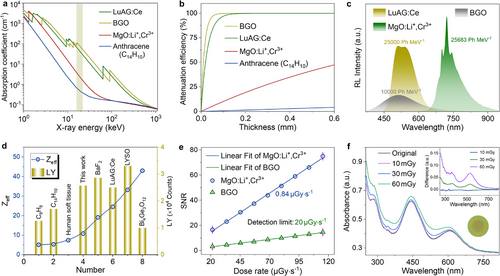
(a,b) Absorption coefficients and calculated X-ray attenuation efficiencies of the MgO:Li+,Cr3+ ceramic compared with commercial LuAG:Ce, BGO, and anthracene scintillators. (c) RL spectra and light yield of different scintillators (X-ray tube voltage, 60 kV; dose rate, 8 mGy s−1; irradiation duration, 30 s). (d) Comparison of effective atomic number _Z_eff and light yield between MgO:Li+,Cr3+ ceramic and various commercial scintillators. (e) Detection limits under low-dose-rate X-ray excitation at an SNR of 3. (f) UV–Vis absorbance of the MgO:Li+, Cr3+ ceramic before and after irradiation with different doses of X-rays, with the insets showing the absorption intensity difference and photographs of the color change after 60 mGy X-ray irradiation.
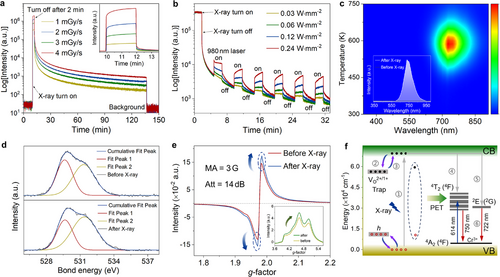
(a) Comparison of X-PersL decay curves of MgO:Li+,Cr3+ ceramic under different dose rate. The inset illustrates the increase in luminescence intensity as a function of charging time. (b) Time-dependent PersL intensity decay of the ceramic under 980 nm laser excitation with varying power densities, following charging with 240 mGy X-rays. (c) Three-dimensional TL spectrum of the MgO:Li+,Cr3+ ceramic as a function of emission wavelength and temperature after 240 mGy X-ray illumination. The insert demonstrates the comparison for TL intensity before and after X-ray charging. (d,e) O 1s XPS spectra and EPR signals for the MgO:Li+,Cr3+ ceramic before and after X-ray charging. (f) A simplified model to describe the X-PersL processes of the ceramic. Inset shows the possible trapping processes at the atomic level, by taking the MgO:Li+,Cr3+ with the intrinsic oxygen vacancy defects as an example. The proposed mechanism includes excitons formation (Process 1), electrons trapping (Process 2), detrapping/ thermal ionization (Process 3), RL (Processes 1, 4, 5, and 6), and persistent energy transfer (PET) process. CB, conduction band; VB, valence band.
在性能表征方面,这种新型陶瓷闪烁体展现出了卓越的指标。其光产率(LY)高达25683 Ph·MeV⁻¹,明显优于传统的LuAG:Ce和BGO商业闪烁体。同时,它的检测限低至0.84 µGy·s⁻¹,仅为临床X射线诊断需求量的约十五分之一。由于氧化镁具有10.8的组织等效有效原子序数,使其在医学剂量学应用中具有天然优势。此外,研究发现陶瓷中与氧空位相关的深陷阱能够实现高效的电子存储,产生持续时间超过120分钟的长余辉发光。
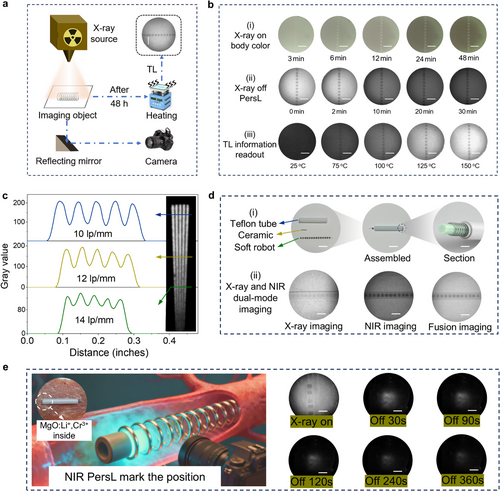
(a) Schematic of a conventional optical lens-coupled X-ray imaging system. (b) Coloration variations of the MgO:Li+,Cr3+ ceramic upon X-ray irradiation with different durations (i), X-PersL images captured at various time intervals after 48 min of continuous X-ray irradiation (ii), and TL images measured at different temperatures after X-ray irradiation for 48 h. Scale bar, 10 mm. (c) Gray value profiles of the 14 lp·mm−1 line pair extracted from the standard line pair card using the MgO:Li+,Cr3+ ceramic-based standard X-ray test pattern. (d) Optical images of the target objects before and after assembly, as well as the corresponding cross-sectional schematic of the device configuration (i), and the results of X-ray and NIR dual-modal imaging (ii). Scale bar, 8 mm. (e) In situ localization of a soft robot via X-ray-excited NIR PersL through 5 mm-thick pork tissue. Scale bar, 6 mm.
为了验证实际应用效果,研究者构建了一个双模成像平台。通过对比发现,传统的X射线成像在穿透不透明特氟龙管时会产生严重的散射,导致内部物体轮廓模糊;而利用该陶瓷将X射线转换为长波长近红外光后,散射效应显著降低,能够清晰地呈现出隐藏软体机器人的形貌轮廓。此外,实验还成功演示了在照射停止后,利用其长余辉特性穿透5毫米厚的猪肉组织进行原位定位,这为降低生物体受到的辐射剂量提供了新路径。
总结及展望
本研究成功开发了一种高性能、大尺寸的MgO:Li+,Cr3+近红外透明陶瓷闪烁体,不仅在光产率和探测灵敏度上取得了突破,还通过独特的能级调控实现了与探测器的高效匹配。该材料兼具优异的物理化学稳定性、组织等效性和长余辉存储能力,为高性能闪烁体的设计提供了全新的化学设计范式。未来,这种材料有望在高端生物医学成像、工业无损探伤以及辐射剂量监测等领域发挥重要作用,推动先进探测技术的跨界融合与产业化应用。