 Fluolab
【Angew.Chem.】性能提升近两倍!精确控制电化学膦酰化策略助力高迁移率共轭聚合物在OECT中的新突破
通讯作者: Shinsuke Inagi (稻木信介)
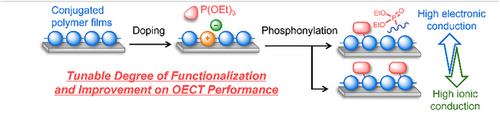
文章概要
在本研究中,研究团队开发了一种基于电化学C–H膦酰化的精确后修饰策略,旨在优化高性能有机电化学晶体管(OECT)中活性层材料的亲疏水平衡。通过引入Nafion复合薄膜电解技术,研究人员成功克服了半结晶高迁移率聚合物(如PBTTT和DPP-DTT)因结构规整、刚性强而难以进行固态反应的挑战,实现了官能化程度(DOF)的精准调控。实验结果表明,适度的膦酰化改性能在不破坏聚合物骨架高效电荷传输特性的前提下,显著增强离子的注入与传输效率。在最优官能化比例下,器件的**值较原始聚合物提升了近两倍**,并展现出更快的开关响应速度和更优异的循环稳定性,为高性能混合导体材料的设计开辟了新路径。
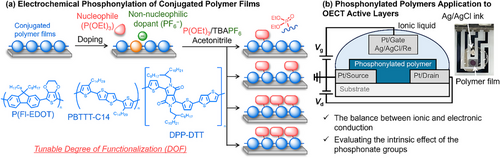
引言
有机电化学晶体管因其能将微弱的生物离子信号转化为显著的电子信号,在柔性传感器和生物电子器件领域备受关注。要实现高跨导性能,活性层材料必须同时具备高电荷迁移率()和高体积比电容()。然而,传统的疏水性共轭聚合物虽然迁移率高,但离子渗透性差;而通过单体重新设计引入亲水侧链的方法不仅合成成本高昂,且往往会破坏聚合物的有序排列,导致迁移率大幅下降。为了解决这一“鱼与熊掌不可兼得”的矛盾,研究团队提出了一种后修饰方案,即直接在成熟的高迁移率聚合物骨架上通过电化学方法引入极性基团。这种方法无需复杂的单体合成,且能通过控制通电量精确诱导亲疏水特性的微调,从而在保持电子传输通道的同时提升离子可及性。
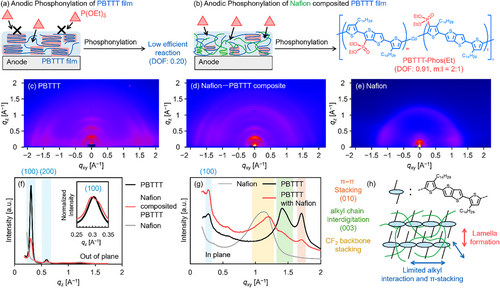
Schematic of anodic phosphonylation of (a) PBTTT and (b) Nafion-composited PBTTT films. 2D GIWAXS profiles of (c) PBTTT, (d) Nafion, and PBTTT composite, and (e) Nafion films. (f) Out-of-plane and (g) in-plane scattering profiles of PBTTT, Nafion, and PBTTT composite, and Nafion films. Diffraction signal assignments correspond to previous reports [45-47]. (h) Schematic image of the PBTTT/Nafion-composite structure.
主要实验及结论
研究团队首先针对PBTTT和DPP-DTT等半结晶聚合物在固态反应中试剂渗透难的问题,创新性地引入了Nafion离子聚合物作为添加剂制备复合薄膜。Nafion的加入不仅降低了聚合物的氧化电位,更通过插层作用减小了结晶区尺寸,从而促进了膦酰化试剂在薄膜内部的均匀扩散。通过调节电解过程中的通电量,研究人员成功制备了一系列具有不同官能化程度(DOF从0.05到0.91)的聚合物样本。表征结果显示,当官能化程度控制在0.06至0.16的适度范围内时,聚合物能够维持其核心的π-共轭长度和边缘取向的结晶形态,同时增加的无定形区为离子提供了丰富的传输通道。
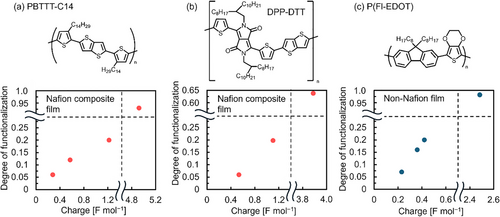
Degree of functionalization (DOF) as a function of the amount of charge passed without (blue dot) and with Nafion (red dot) for the anodic phosphonylation of (a) PBTTT-C14, (b) DPP-DTT, and (c) P(Fl-EDOT). The red and blue dots represent the Nafion/conjugated polymer film reactions and the conjugated polymer film reactions, respectively.
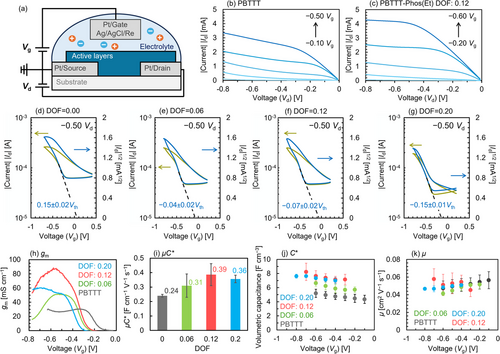
(a) Schematic illustration of an OECT device with circuit. characteristics of (b) PBTTT and (c) PBTTT-Phos(Et) with DOF of 0.12. characteristics (brown line) and plot (blue line) of (d) PBTTT and (c) PBTTT-Phos(Et) with (e) DOF 0.07, (f) DOF 0.16, and (g) DOF 0.20 measured in [BMPyrr][TFSI] using Pt IDMEs with an Ag/AgCl gate electrode. (h) Plot of versus . (i) Relationship between and DOF. (j) Volumetric capacitance of PBTTT and PBTTT-Phos(Et) across several gate voltages. (k) Plot of µ versus .
在OECT器件性能测试中,经过适度膦酰化的PBTTT-Phos(Et)表现出惊人的性能飞跃,其关键性能指标达到了90 mS cm⁻¹,而DPP-DTT改性后的性能提升更是接近两倍。研究发现,随着极性膦酰基团的引入,器件的跨导显著增强,迟滞现象大幅减轻,这归功于体积比电容的有效提升。此外,在开关响应行为测试中,改性后的材料展现出更短的时间常数,尤其是在退掺杂(关断)过程中的响应速度明显加快,有效克服了传统疏水材料的“记忆效应”。稳定性测试进一步证实,膦酰化改性使聚合物在充放电循环中能够保持更稳固的层状结构,避免了离子反复嵌入导致的结构崩坏,循环100次后电流保持率高达97%。
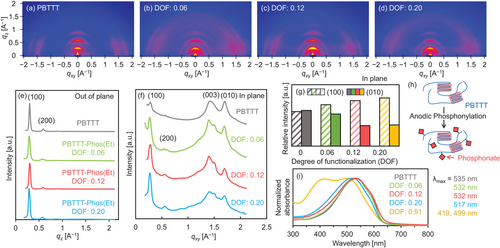
2D GIWAXS images of (a) PBTTT, PBTTT-Phos(Et) with (b) DOF 0.06, (c) DOF 0.12, and (d) DOF 0.20. All samples were annealed at 150°C before the measurements. (e) Out-of-plane and (f) in-plane scattering profiles of PBTTT and PBTTT-Phos(Et) (DOF: 0.06, 0.12, and 0.20). (g) Relative intensity ratio of (010) and (100) peaks for PBTTT and PBTTT-Phos(Et) (DOF: 0.06, 0.12, and 0.20) from the in-plane scattering profiles. (h) Schematic polymer structure before and after anodic phosphonylation. (i) UV-vis absorption spectra of PBTTT and PBTTT-Phos(Et) (DOF: 0.06, 0.12, 0.20, and 0.91) films. Numbers represent the maximum wavelength of each sample film.
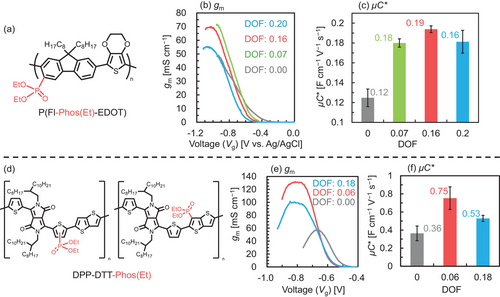
Chemical structure of (a) P(Fl-Phos(Et)-EDOT) and (d) DPP-DTT-Phos(Et). Plot of versus for (b) P(Fl-Phos(Et)-EDOT) and (e) DPP-DTT-Phos(Et). Relationship between µC* and DOF of (c) P(Fl-Phos(Et)-EDOT) and (f) DPP-DTT-Phos(Et).
总结及展望
这项工作证明了电化学后修饰技术在调控有机电子材料性能方面的巨大潜力。通过在现有的高性能疏水聚合物骨架上进行“外科手术式”的微量官能化,研究团队成功打破了电子传输与离子传输之间的权衡限制。这种方法具有极高的通用性,不仅适用于半结晶聚合物,也适用于无定形及供体-受体(D-A)型聚合物系统。未来,这种精确可调的电化学膦酰化策略有望成为开发新型混合离子/电子导体材料的标准工具,为下一代高灵敏度生物传感终端和低功耗可穿戴电子设备提供核心材料支撑。此外,该研究所揭示的微观结构与宏观电化学性能之间的定量关系,也为理解复杂有机混合导电系统提供了宝贵的物理洞察。