 Fluolab
【Angew.Chem.】四川大学彭强、吴义辉|27.05%效率巅峰!光互变异构驱动能量转移,打造超稳钙钛矿电池
通讯作者: Yihui Wu, Qiang Peng
文章概要
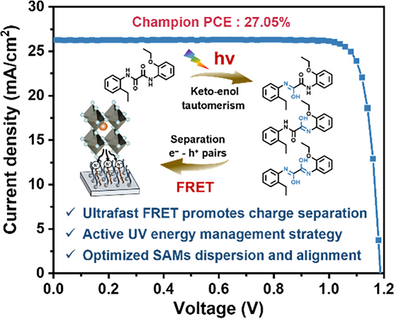
在本研究中,四川大学彭强教授与吴义辉副教授团队针对钙钛矿太阳能电池在紫外线照射下极易退化的痛点,提出了一种创新的主动能量管理策略。研究团队通过在空穴传输层与钙钛矿的界面处引入紫外吸收剂UV-312,成功构建了福斯特共振能量转移(FRET) 通道。该策略不仅显著提升了器件的光电转换效率,更在提升钙钛矿电池的长期紫外稳定性、热稳定性以及大面积制备方面展现了巨大的应用潜力。
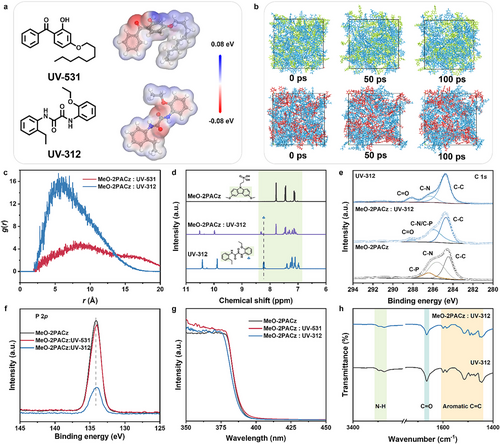
(a) Molecular structures and electrostatic potential (ESP) maps of UV-531 and UV-312. (b) Molecular dynamics (MD) snapshots at 0, 50, and 100 ps for MeO-2PACz blended with UV-531 (up) or UV-312 (down) (Blue, green, and red correspond to MeO-2PACz, UV-531, and UV-312, respectively). (c) Radial distribution function (RDF) plots for MeO-2PACz:UV-531 and MeO-2PACz:UV-312 blends. (d) 1H NMR spectra of pristine MeO-2PACz, UV-312, and MeO-2PACz:UV-312 blend. (e) C 1_s_ XPS core-level spectra of pristine UV-312, MeO-2PACz and MeO-2PACz:UV-312 blend. (f) P 2_p_ XPS core-level spectra of pristine MeO-2PACz and its blends with UV-531 or UV-312. (g) UV-vis absorption spectra of pristine MeO-2PACz and its blends with UV-531 or UV-312. (h) FT-IR spectra of pristine UV-312 and the MeO-2PACz:UV-312 blend.
引言
钙钛矿太阳能电池虽已取得令人瞩目的转换效率,但其商业化进程仍受困于长期稳定性问题,尤其是紫外线诱导的退化。高能紫外光子会直接导致钙钛矿内部Pb-I键断裂,并诱发界面处的离子迁移与化学反应,严重缩短器件寿命。传统的紫外防护手段多采用被动屏蔽或下转换材料,往往面临能量捕获效率低或产生多余热量的困境。为了化被动为主动,研究团队探索利用具有光诱导酮-烯醇互变异构特性的分子,试图将有害的紫外能量转化为驱动电荷分离的动力,从而实现效率与稳定性的双重突破。
主要实验及结论
研究人员选取了UV-312作为核心功能分子,并将其掺入常见的自组装单分子层(SAM)空穴传输材料MeO-2PACz中。实验发现,UV-312凭借其刚性的共轭结构和多位点氢键能力,极大地改善了SAM分子的分散性,形成了更加均匀致密的空穴传输网络。通过分子动力学模拟与多种能谱分析证实,UV-312与MeO-2PACz之间存在强烈的π-π相互作用和偶极-偶极相互作用,这不仅降低了空穴传输的能垒,还为后续钙钛矿薄膜的生长提供了理想的基础。在钙钛矿结晶过程中,UV-312能有效钝化埋底界面的铅空位缺陷,诱导形成粒径更大、结晶度更高的优质薄膜。
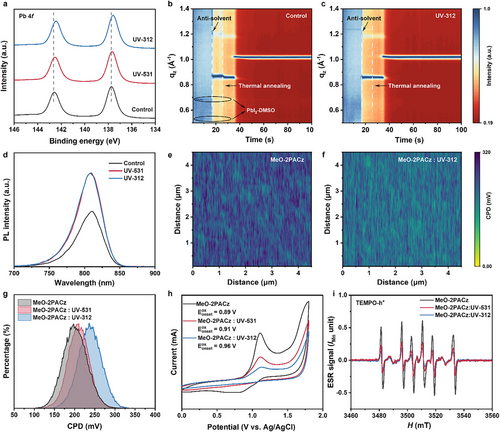
(a) Pb 4_f_ XPS core-level spectra of the control, UV-531, and UV-312 modified perovskite films. In situ GIWAXS patterns of the (b) control and (c) UV-312-modified perovskite films. (d) Steady-state PL spectra of the control, UV-531, and UV-312-modified perovskite films excited at 512 nm. KPFM surface potential images of (e) MeO-2PACz and (f) MeO-2PACz:UV-312 films. (g) CPD distributions extracted from KPFM for MeO-2PACz, MeO-2PACz:UV-531, and MeO-2PACz:UV-312. (h) Cyclic voltammetry (CV) curves of MeO-2PACz, MeO-2PACz:UV-531, and MeO-2PACz:UV-312. (i) ESR spectra of TEMPO for h+ trapping for MeO-2PACz, MeO-2PACz:UV-531, and MeO-2PACz:UV-312 under illumination for 5 min.
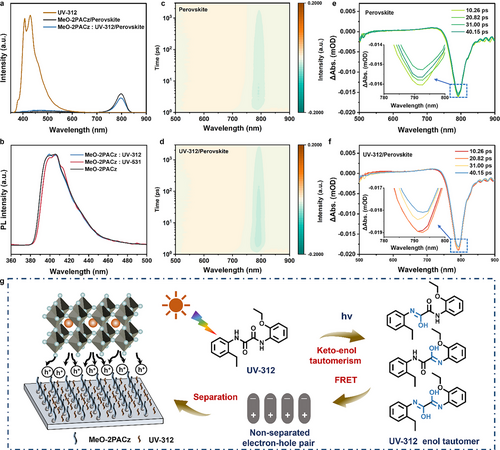
(a) PL spectra of UV-312, MeO-2PACz/perovskite, and MeO-2PACz:UV-312/perovskite under 340 nm excitation. (b) PL spectra of the pristine MeO-2PACz, MeO-2PACz:UV-531, and MeO-2PACz:UV-312 under 340 nm excitation. TAS maps of (c) the pristine and (d) UV-312-modified perovskite films. Kinetic traces of ΔAbs extracted at specific probe wavelengths from the TAS maps in (e) perovskite and (f) UV-312/perovskite for the time window of 10.26–40.15 ps (inset showing partial enlarged views). (g) Schematic illustration of the UV-312 molecule undergoing photoinduced keto-enol tautomerization to facilitate interfacial carrier separation in perovskite via the FRET process.
核心的物理机制在于超快能量转移过程。瞬态吸收光谱测定显示,在紫外光照射下,UV-312会在约20皮秒内完成从酮式到烯醇式的互变异构,并迅速通过FRET通道将激发态能量转移至钙钛矿界面。这一过程有效抑制了紫外光对铅碘骨架的破坏,同时将能量直接转化为可移动的载流子,显著提升了界面电荷提取效率。得益于这种多功能的界面修饰,实验室小型器件实现了高达27.05%的记录级转换效率,其开路电压损失降低至惊人的61毫伏。此外,该技术展现出优异的扩展性,在12.96平方厘米的微型组件上依然保持了23.00% 的高效率。
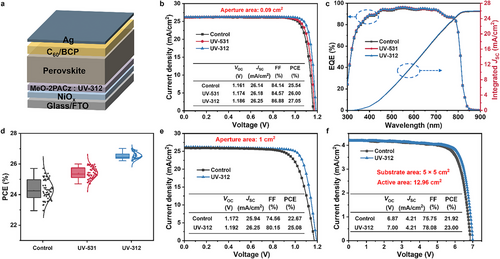
(a) Schematic diagram of the fabricated PSCs device structure. (b) J–V curves of the control, UV-531, and UV-312 modified PSCs (aperture area: 0.09 cm2). (c) EQE curves and the corresponding integrated current density curves of the control, UV-531, and UV-312-modified PSCs. (d) PCE distribution of 60 individual control, UV-531, and UV-312-modified devices. (e) J–V curves of the control and UV-312-modified PSCs (aperture area: 1 cm2). (f) J-V curves of the control and UV-312-modified mini-modules (active area: 12.96 cm2).
在稳定性测试中,优化后的器件表现出卓越的耐受力。在连续1185小时的最大功率点跟踪测试后,器件仍能保持初始效率的90%以上。同时,面对严苛的紫外光暗循环测试和85摄氏度的高温老化环境,引入UV-312的电池寿命远超对照组。这主要归功于功能分子对钙钛矿晶格完整性的保护以及对界面缺陷的深度修复,从根本上遏制了离子迁移和结构相变的发生。
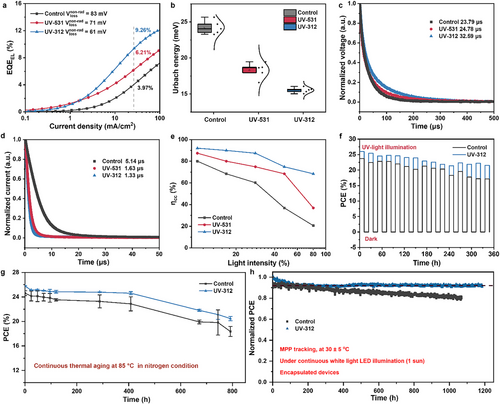
(a) EQEEL as a function of injection current density for the control and UV absorber-treated devices. (b) Urbach energy (EU) of the perovskite films without and with UV absorber treatment. (c) TPV and (d) TPC decay curves of the control and UV absorber-treated devices. (e) Charge collection efficiency (_η_cc) profiles of the control and UV absorber-treated PSCs. (f) Stability of the control and UV-312-modified devices under light-dark (12 h/12 h) cycled UV-light (365 nm) illumination in an N2-filled glovebox. (g) Stability of the control and UV-312-treated devices under 85°C heating in N2-filled glove box (standard deviation was calculated from three devices for each group). (h) MPP tracking of the control and UV-312-treated devices under 1-sun equivalent white LED illumination.
总结及展望
这项工作为钙钛矿电池的界面工程开辟了新路径,通过将传统的紫外吸收剂转变为主动的能量管理单元,成功解决了光伏器件在高效与长效之间的矛盾。研究证明,通过分子设计调控激子动力学,不仅可以榨取高能紫外光子的能量价值,还能构建坚韧的化学屏障。这种策略具备极强的普适性,能够兼容多种不同的自组装分子体系和钙钛矿组分,为未来开发长寿命、低成本的商业化钙钛矿组件提供了重要的技术支撑和理论指导。